
Quick Answer
Repeat roof leaks are often caused by the original problem not being repaired properly.
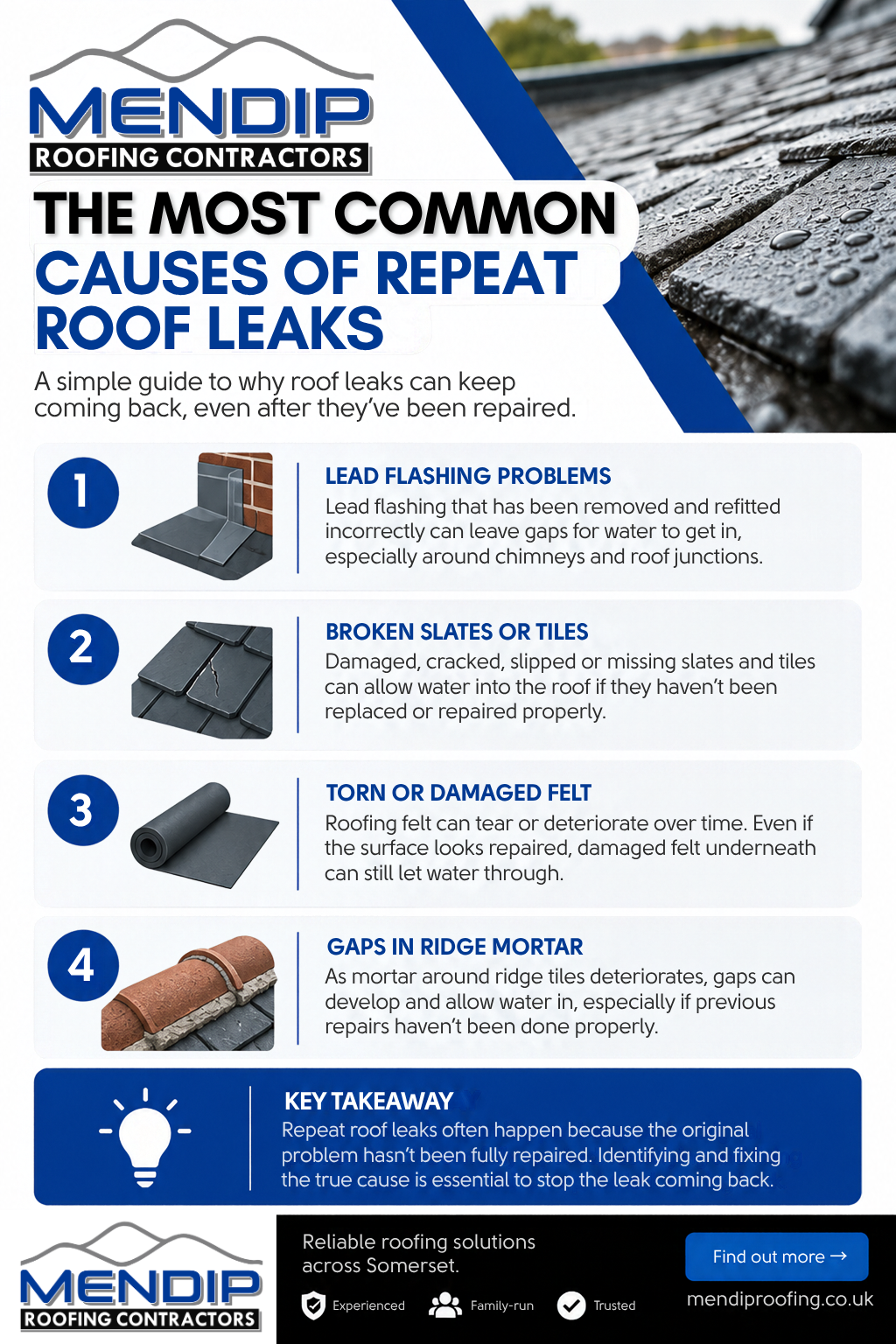
Common issues include lead flashing that has been refitted incorrectly, broken or damaged slates and tiles, torn roofing felt and gaps in the mortar around ridge tiles.
While a previous repair may appear to have solved the leak temporarily, water can return if the underlying fault remains.
A repeat leak doesn’t necessarily mean the whole roof needs replacing. The important thing is to identify the true cause of the water ingress and repair it correctly, rather than repeatedly patching the visible symptoms.
The Same Problems, Over Again
When a roof starts leaking again after it has already been repaired, it’s easy to assume that a completely new problem has developed.
Sometimes that’s the case. But in our experience at Mendip Roofing Contractors, a repeat leak can often mean that the original problem hasn’t been repaired properly in the first place.
Incorrectly fitted lead flashing, broken tiles or slates, damaged felt and deteriorating mortar around ridge tiles can all allow water back into a property.
Why do some roof leaks keep coming back?
A roof repair needs to deal with the actual point of failure rather than simply covering the visible symptoms.
As the founder of Mendip Roofing Contractors explains:
“If a roof keeps leaking, quite often the original problem hasn’t been repaired properly. It could be lead flashing that’s been put back incorrectly, broken slates or tiles, torn felt or gaps in the mortar around the ridge.”
This fits with what we regularly see when inspecting previously repaired roofs. A repair might look as though it has solved the problem initially, but if the underlying fault remains, water can eventually find its way back in. Previous repairs sometimes cover rather than resolve the underlying problem.
Why might your roof be leaking again?
Tick any issues you know or suspect may apply to your roof.
Select anything you've noticed or know about your roof.
A repeat leak doesn't necessarily mean your whole roof needs replacing. The important thing is identifying the actual source of the water ingress.
Lead flashing that hasn't been fitted correctly
Leadwork helps keep vulnerable roof junctions watertight, including areas around chimneys and other roof details.
If flashing has been removed during previous work and then put back incorrectly, it can leave an opportunity for water to penetrate the roof.
The important thing is therefore not simply whether lead flashing is present, but whether it has been installed and detailed properly. Mendip Roofing regularly deals with failing flashing and leadwork as part of our roof repair services.
Broken slates and tiles
Slates and tiles form the main weatherproof covering on a pitched roof, so damaged sections can provide another route for water.
A slate or tile may be cracked, broken, slipped or missing. If the damaged area hasn’t been correctly addressed during an earlier repair, the leak may continue or return during periods of bad weather.
These are common faults we encounter during roof repair work, and damaged or missing slates can potentially allow water into the roof structure if left unresolved.
Torn or damaged roofing felt
The problem isn’t always visible from the outside.
The felt or membrane beneath the tiles forms another important part of the roofing system. If this has torn or deteriorated, simply addressing something on the surface may not resolve the wider problem.
This is particularly relevant on older roofs where the underlay may have deteriorated more extensively. In these cases, repeatedly patching one area may only provide a temporary answer if the roofing system itself is beginning to fail.
Gaps in mortar around ridge tiles
Ridge tiles are another area we usually look at when investigating repeat leaks.
Traditional ridge tiles can rely on mortar, and as that mortar deteriorates, gaps can develop. If previous repairs haven’t dealt with the failed mortar properly, water may continue finding a route into the roof.
We’ve also encountered roofs where fresh cement has effectively been applied over old, failing mortar rather than the ridge being properly stripped, cleaned and relaid.
The important thing is fixing the cause
A repeat roof leak doesn’t automatically mean that the whole roof needs replacing.
If the problem is localised, the right repair may be all that’s required. But if a leak keeps returning, it’s important to establish why the previous work hasn’t solved it rather than continually applying another patch.
At Mendip Roofing Contractors, we investigate the source of roofing problems and explain what needs to be done before carrying out the repair. Our approach is straightforward: repair what can sensibly be repaired, but make sure the work deals with the real cause of the leak.