Quick Answer
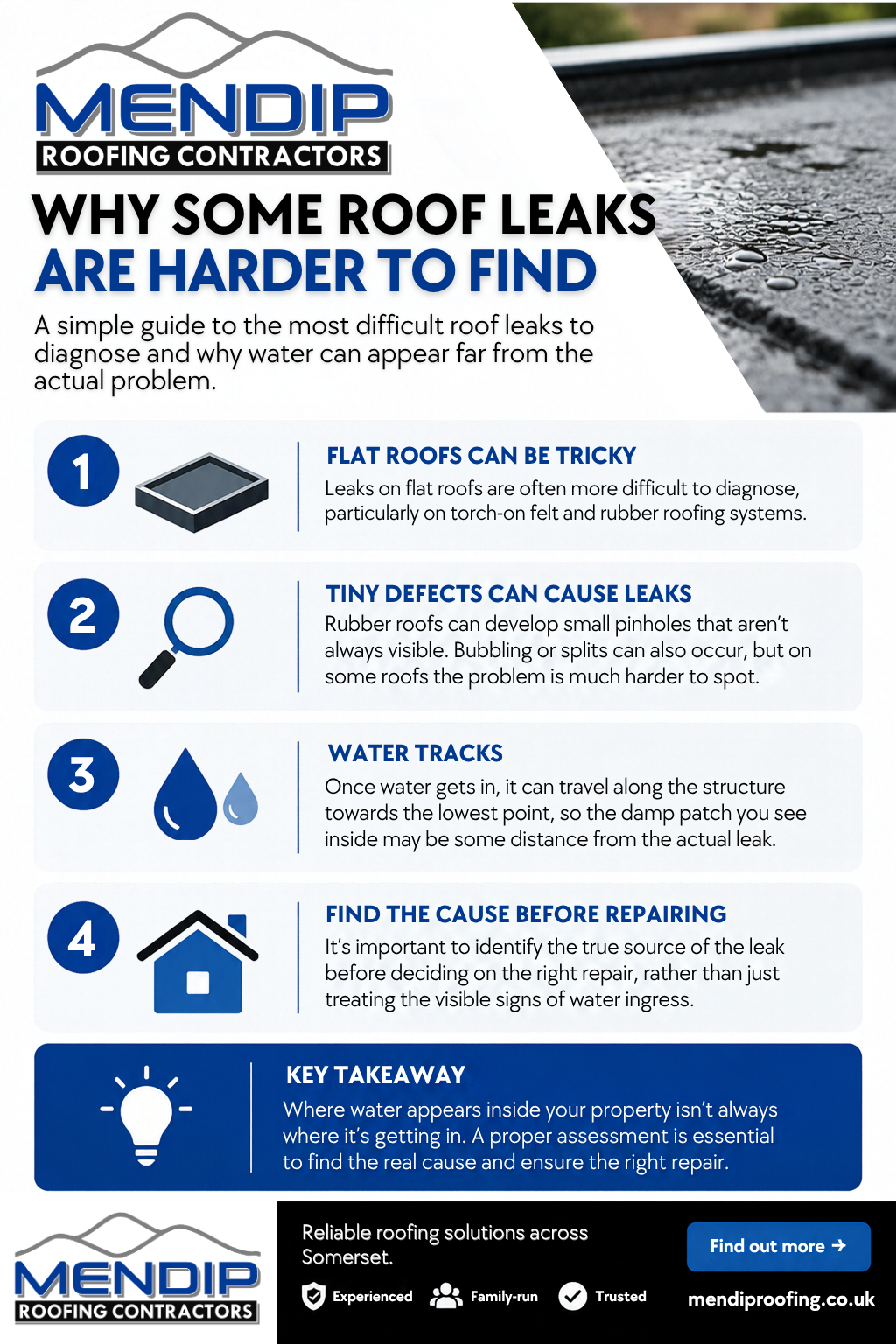
Flat roof leaks can be particularly difficult to diagnose, especially on rubber and torch-on felt roofs. Small pinholes, bubbles or splits can allow water to enter without making the source immediately obvious.
To make matters more difficult, water tracks towards the lowest point, meaning the damp patch or leak you see inside your property may be some distance from the actual roof defect.
That’s why identifying the true source of water ingress is an important first step before deciding how a leaking roof should be repaired.
Finding The Source Matters
A leaking roof can sometimes look straightforward from inside the property. You find a damp patch or water coming through the ceiling, so it seems reasonable to assume the problem must be directly above it.
Unfortunately, roof leaks don’t always work like that. At Mendip Roofing Contractors, some of the more difficult leaks we encounter are on flat roofs, particularly torch-on felt and rubber roofing systems. The point where water appears inside the property can also be some distance from the actual defect.
That’s why finding the source of a leak matters just as much as repairing the visible signs of water ingress.
Why can flat roof leaks be difficult to find?
In our experience, flat roof leaks can be among the trickiest to diagnose. Torch-on felt roofs can develop problems that aren’t immediately obvious from looking at the area where water is appearing internally. Rubber roofs can be particularly difficult because the defect itself may be extremely small.
Our director and founder explains:
“Rubber roofs can be some of the hardest leaks to find because you can get tiny pinholes in them. Sometimes they’ll bubble or split and the problem is more obvious, but on certain roofs it can be much harder to tell exactly where the water is getting in.”
Mendip Roofing works with a range of flat roofing systems and provides leak investigation and repair services throughout Somerset and the South West. When a flat roof is showing signs of deterioration, we assess the existing surface and determine whether a targeted repair or a more comprehensive solution is needed.
What have you noticed?
Tick any signs you've spotted. These details can help when investigating where a roof leak may be coming from.
Tick the signs you've noticed to create a quick summary.
Remember: water can track along a roof structure, so where damp appears inside isn't necessarily where water is getting in.
Small pinholes can cause bigger problems
One of the difficulties with rubber roofing is that the point of failure doesn’t necessarily need to be large.
A small pinhole can be enough to allow water through, but locating that tiny defect across the surface of a flat roof isn’t always straightforward.
Other problems may be easier to spot. Rubber roofing can sometimes bubble or split, giving the roofer a clearer indication of where the system has failed.
This is why we don’t recommend assuming that the most visible part of a leaking roof is automatically where the repair needs to be made.
Why does water appear away from the actual roof leak?
Quite simply, water tracks.
Once water gets through the roof covering, it can travel along the structure towards the lowest point before eventually becoming visible inside the property.
As our founder puts it:
“Water tracks. It runs to the lowest point, so where you see the water coming through isn’t necessarily where the actual problem is.”
This can make diagnosing a leak deceptive. The damp patch on a ceiling tells us that water is getting into the property, but it doesn’t necessarily identify the original entry point.
Simply repairing the roof directly above the visible damp therefore risks treating the wrong area.
Finding the cause before deciding on the repair
The same principle runs through our approach to roofing repairs generally: understand what is actually causing the problem before deciding what needs doing.
Mendip Roofing provides repairs for leaks and water ingress as well as flat roof deterioration, and where an urgent leak occurs, our priority is to identify the issue where possible and reduce further water entering the property.
For flat roofs specifically, that means assessing the condition of the existing surface and its weak points before recommending whether a repair, overlay or replacement is the appropriate option.
Not every leak means you need a new roof. Equally, repeatedly patching the visible symptoms isn’t the right answer if there’s a wider failure in the roofing system. That’s why we focus on identifying the source first and giving homeowners straightforward advice about what actually needs to be done.
Got a roof leak you're struggling to trace?
Whether you’ve spotted a damp patch, have water coming through during heavy rain or have a flat roof that has started bubbling, splitting or leaking, it’s worth having the problem properly assessed.
Mendip Roofing Contractors is a family-run roofing business with more than 16 years of hands-on experience and five generations of family roofing behind us. Our approach is based on honest advice, clear communication and dependable workmanship, whether we’re carrying out a small repair or dealing with a more substantial roofing problem.