
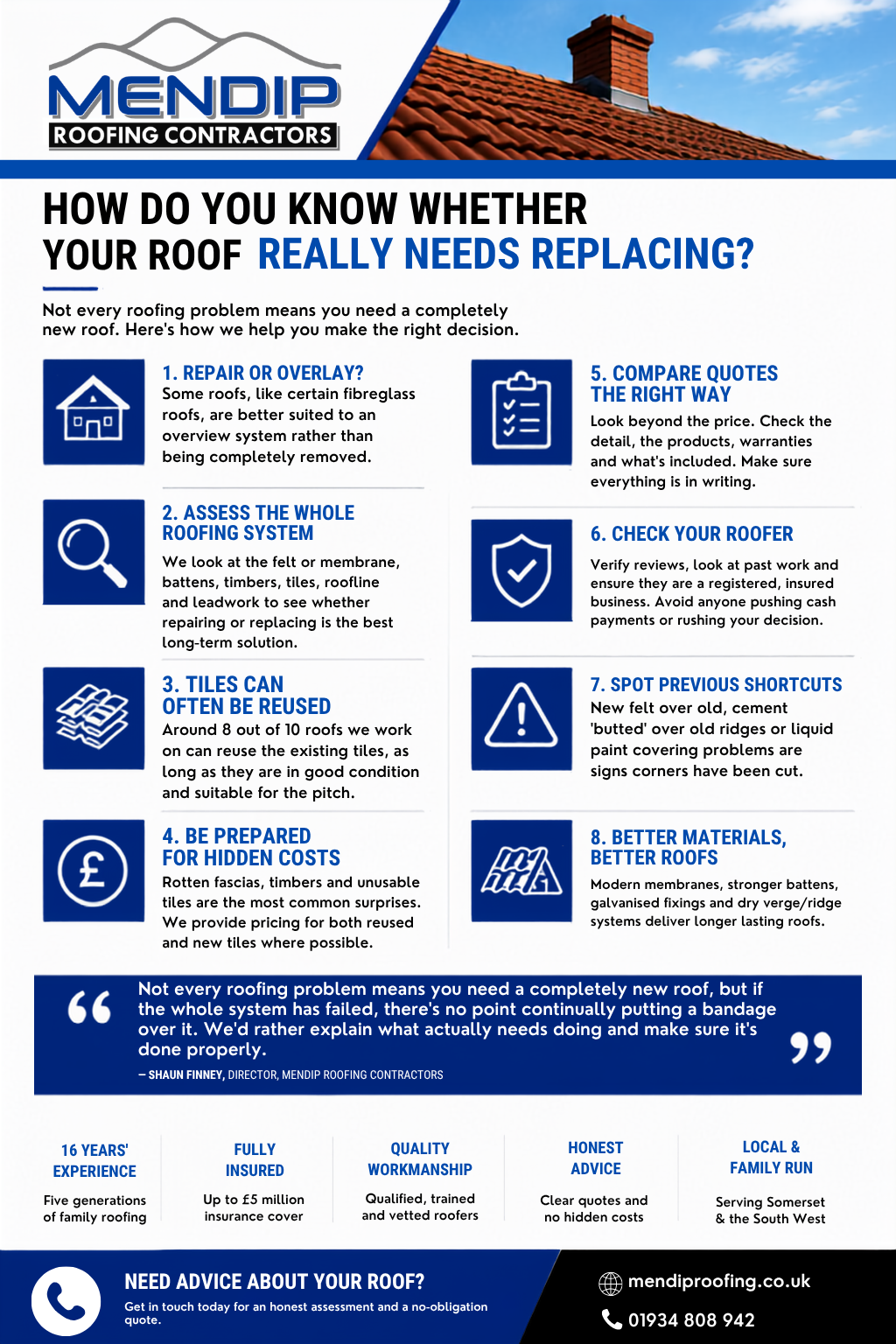
Quick Answer
Not every roofing problem means you need a complete roof replacement. A localised fault may be suitable for repair, while some fibreglass roofs are better suited to an overlay system rather than being completely removed.
However, if problems affect the wider roofing system, continually patching individual areas can simply put a temporary fix over a bigger issue. The condition of the felt or membrane, battens, timbers, tiles and roofline all need to be considered.
At Mendip Roofing Contractors, we assess what is actually causing the problem before recommending the appropriate solution. If a repair makes sense, we’ll advise accordingly. If the roof has deteriorated to the point where replacement offers the better long-term solution, we’ll explain why and what the work involves.
To Replace Or Not To Replace...
If your roof is leaking or beginning to show its age, it is easy to assume that the answer must be a completely new roof.
Sometimes it is. Sometimes it isn’t.
At Mendip Roofing Contractors, our job is to look at the roof, understand what is actually failing and recommend an appropriate solution. We are not interested in replacing something simply because replacement is the biggest job available.
The right answer depends on the type of roof, the condition of its materials and whether the problem is isolated or affects the roofing system more widely.
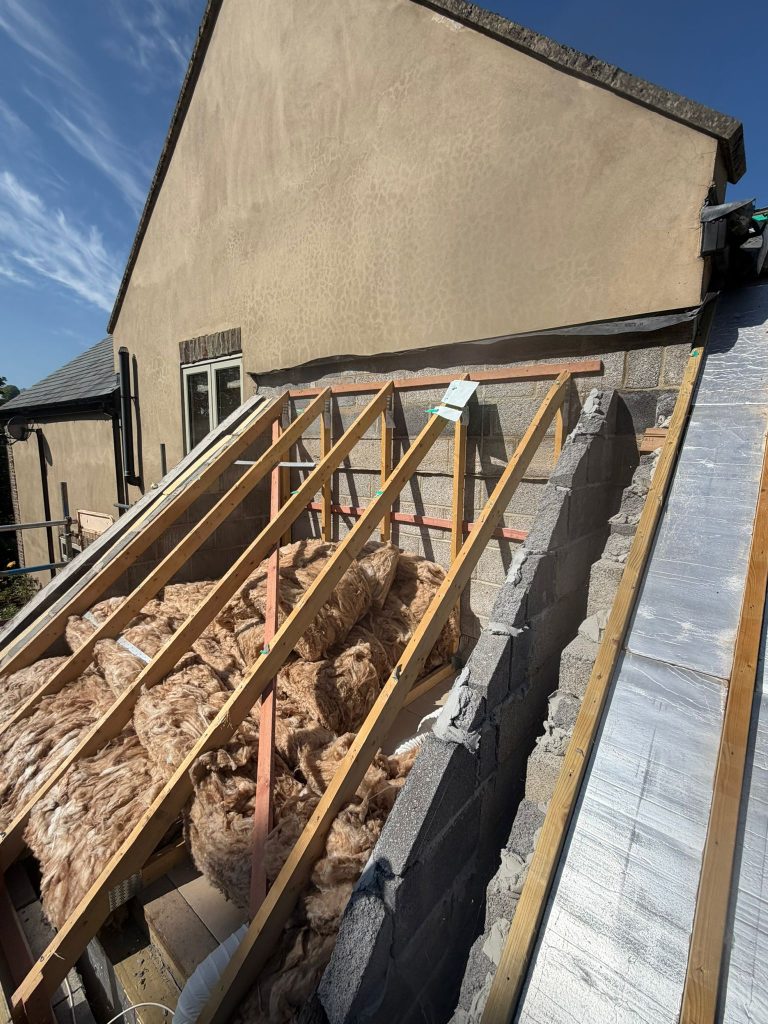
Not every problematic roof needs to be stripped off
There are roofs that we would actively advise against trying to replace in the conventional way.
One example is certain fibreglass roofs found on newer properties.
Some of these have effectively been constructed as one complete unit, which means you cannot simply dismantle and remove the roof covering in the same way you would strip tiles from a traditional pitched roof.
In circumstances like this, an overlay system can make much more sense.
Rather than unnecessarily trying to dismantle the existing structure, the fibreglass can be prepared, repaired where necessary and overlaid with a suitable new fibreglass system.
It is a good example of why the right roofing solution should be based on the construction of the building rather than assuming every problem requires exactly the same response.
Does your roof need a closer look?
Tick anything that applies to your roof. These are some of the areas worth checking before deciding between a repair and replacement.
This checklist is a guide only. Ticking an item does not necessarily mean your roof needs replacing. The condition of the complete roofing system should be assessed before deciding on the right solution.
At the other end of the scale, some roofs need more than another patch
There are also situations where repeatedly repairing small areas stops making sense.
If an old roofing felt has deteriorated, for example, the problem may not be limited to the small area where water has happened to appear.
Patching one section can simply put a bandage over an ageing system.
We take a similar approach to details such as a failing verge. If the existing material has deteriorated, we would generally rather strip the affected verge properly and relay it than apply another small amount of mortar over old failing material.
Where a roof genuinely needs substantial renewal, doing the job properly can provide much better long-term value than repeatedly paying for small repairs to the same ageing components.
Targeted repairs can be a sensible way to extend the life of a roof, but the starting point should always be identifying what has actually gone wrong and whether repairing it remains cost-effective in the longer term.
Age alone does not tell you everything
The type and age of roof also affect the replacement decision.
A Victorian or 1930s roof can look very different once we begin stripping it compared with a more recently installed estate roof.
On older properties, battens are often one of the biggest differences. Historic roofs did not necessarily use the stronger graded timber battens available today, so the existing battens may need replacing.
Chimney detailing can also differ. Some older roofs use cement detailing where a modern roof would normally incorporate leadwork.
A more recent tiled roof may already have better lead details and good-quality tiles that can potentially be reused.
So although the age of the roof matters, what really matters is the condition and suitability of its individual components.
Existing roof tiles may still be worth keeping
A roof replacement does not automatically mean throwing away every existing tile.
In fact, on many of the roofs we work on, the tiles can be reused.
Based on our own workload, we estimate that approximately eight in ten roofs can involve reusing the existing tiles.
The important thing is their condition.
Once removed, we need to look at how worn they are, whether their channels remain serviceable, how many have broken and whether that particular tile is appropriate for the pitch of the roof.
A good existing tile that still has plenty of useful life does not necessarily need replacing simply because the membrane and battens underneath it do.
Equally, we will not recommend putting tiles back simply to reduce the initial cost if we do not believe they remain suitable.
Be prepared for things that cannot be seen before stripping
One reason homeowners can find reroofing difficult to budget for is that some conditions only become apparent once the roof is opened up. To find out more about this, read our blog post on what problems can be discovered during a roof replacement.
Rotten fascias and roof timbers are among the main examples we encounter.
A plastic fascia covering can hide deteriorated timber behind it. Rafter ends may have suffered rot around the eaves, rafters can occasionally be split and gable-end timbers can have deteriorated.
Tiles are another potential variable. Although they may initially look reusable, removing them can reveal extensive wear or result in more breakages than expected.
Where possible, we account for that uncertainty by discussing both the reuse and new-tile options when pricing a roof.
We’re straightforward about the possibilities rather than producing an attractive initial price and allowing avoidable surprises to appear later.
A detailed roof quote matters
This leads into one of the biggest mistakes we see homeowners make when choosing somebody to replace their roof: comparing quotes based primarily on the final number.
The detail behind that number is important!
A written roofing quote should make it clear what work is actually being carried out and what products are being installed.
If new tiles are included, find out exactly which tiles they are. Understand what manufacturer warranty comes with them and what workmanship guarantee the roofer provides themselves.
Look at what else is included too.
On our own projects, for example, we can arrange scaffolding and remove waste using tipper trailers, helping keep the job organised and minimise unnecessary disruption around the property.
Two quotes with different totals may not actually be quoting for the same specification.
Check the roofer as carefully as the quote
We also strongly recommend checking the company carrying out the work.
Look at their previous projects. Look through their photographs and social media presence. Read and verify their reviews. Check that you are dealing with an established business and make sure important details are provided in writing.
Be cautious where somebody is pushing heavily for cash, rushing you into the quickest possible option or is reluctant to give you a detailed written quote.
A roof is too important to choose a contractor simply because somebody can start tomorrow.
Mendip Roofing Contractors is a fully accredited and insured roofing company, with up to £5 million insurance cover for our team and work on site. Our roofers are qualified, regularly trained and vetted, and our business is backed by 16 years’ experience and five generations of family roofing.
Poor previous repairs can often leave clues
Unfortunately, when replacing or repairing roofs we sometimes see the results of previous work that has only covered up a problem.
One obvious sign is that a supposedly repaired roof continues to leak.
We can also encounter new felt that has simply been placed over an older failed felt rather than the roof being dealt with properly.
Traditional ridge repairs are another example. Sometimes fresh cement has effectively been applied over old failing mortar rather than the ridge being stripped, cleaned and relaid correctly.
Liquid coatings can also sometimes be used as a quick attempt to cover an underlying issue rather than resolve its cause.
That is why we focus on understanding the actual fault before recommending the work.
Repair when a repair makes sense. Replace when replacement makes sense.
Ultimately, there should not be an automatic answer to every roofing problem.
A localised defect on an otherwise sound roof may be suitable for repair. Certain fibreglass roofs may be much better suited to an overlay. An ageing tiled roof with failing felt, battens and roofline details may justify a much more comprehensive replacement.
The important thing is identifying which situation you actually have.
At Mendip Roofing Contractors, we start with an inspection and straightforward conversation about the condition of the roof. From there, we can explain what has gone wrong, what needs doing and whether repairing or replacing it is likely to offer the better long-term solution.
Our focus is the same whether we are carrying out a small repair or a full reroof: practical advice, properly specified materials and workmanship designed to last.